Call for Papers
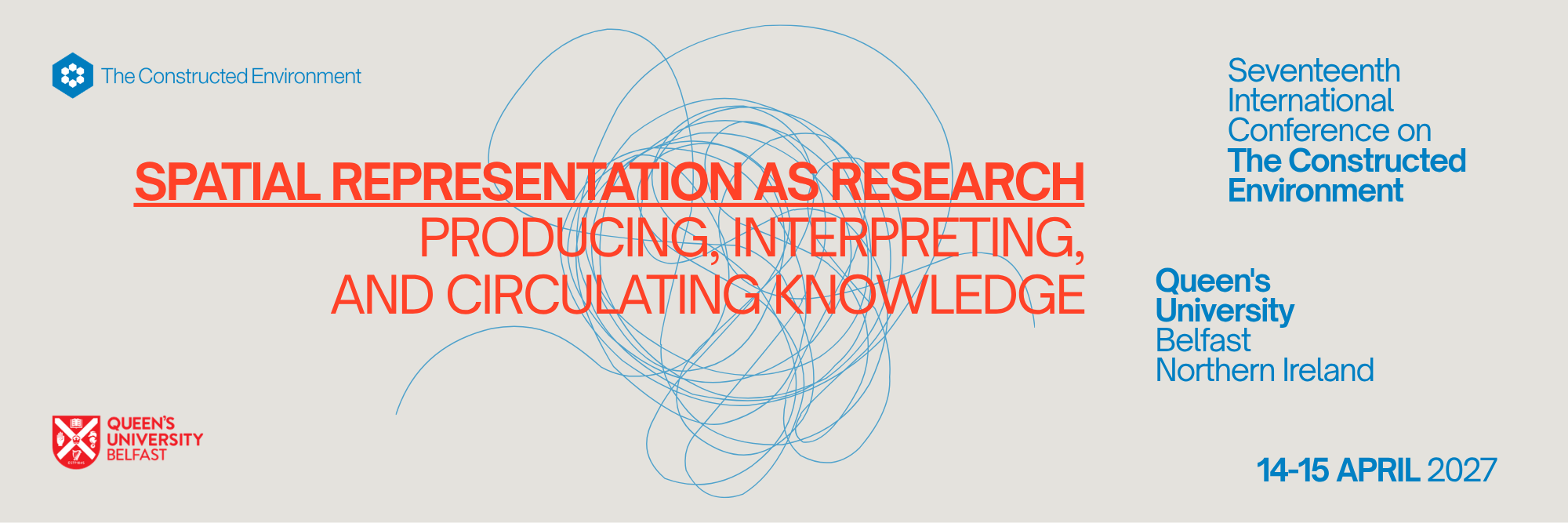
Call for Papers
We warmly invite you to participate in the Seventeenth International Conference on The Constructed Environment, the annual conference of the Constructed Environment Research Network, hosted by Queen’s University Belfast, Northern Ireland, and convened from 14–15 April 2027, with online participation available.
Over its history, the conference has brought together scholars, practitioners, and educators working across architecture, planning, landscape, and urban studies to examine how spatial environments are designed, constructed, inhabited, and transformed. Alongside the conference’s regular thematic streams, the 2027 conference foregrounds spatial representation as research—positioning representational and practice-based methods as central to the production, interpretation, and circulation of spatial knowledge.
Spatial knowledge emerges through representational and practice-based research methods that not only document but actively construct, test, and communicate understandings of space across physical, digital, and archival media. Design experimentation, spatial analysis, ecological and climatic modelling, participatory planning, construction processes, and heritage and infrastructural documentation all generate artefacts that function within wider media-ecologies: drawings, models, datasets, simulations, serious games, audio-visual material, spatial narratives, and other mixed-media forms. These outputs may operate simultaneously as research processes, evaluative tools, and evidence of impact. As these materials move between studio and site, agency and archive, neighborhood and region, they are reinterpreted and recontextualized, accruing new meanings, supporting reflection, evaluation, and longer-term scholarly and societal impact.
The conference invites contributions that examine the creative, material, digital, and institutional ecologies through which spatial knowledge is produced, represented, evaluated, and circulated: how digital assets are created, reused, adapted, or preserved; how planning and heritage systems operate as circular knowledge infrastructures; how spatial information travels between disciplines, publics, and regulatory frameworks; and how non-traditional outputsbeyond print and static representation, such as exhibitions, prototyping, moving imagery and digital modelling, can be recognized as legitimate, citable contributions.
In alignment with the Constructed Environment Research Network’s core themes, space and place, construction processes, environmental impacts, and social dynamics, this focus extends inquiry beyond built form to include the cultural, digital, and archival environments in which knowledge about spatial systems is produced, negotiated, sustained, and sometimes contested. It asks how spatial thinking is institutionalized, how it circulates across multiple media and scales, and how it can intentionally articulate, evaluate, and evidence impact in shaping future spatial, environmental, and social conditions.
Themes
Proposals are welcomed across the breadth of Constructed Environment scholarship, including but not limited to the following sub-themes:
Spatial Representation as Knowledge Production: Drawing, modelling, mapping, simulation, and visualisation as research methods; research-by-design and practice-based inquiry; representational practices as analytical, generative, and evaluative tools.
Media Ecologies of Spatial Knowledge: The material, digital, and institutional ecologies through which spatial knowledge circulates, including datasets, digital models, simulations, mixed-media outputs, and emerging representational technologies.
Planning, Governance, and the Circulation of Evidence: Spatial representation in planning, policy, and regulation; participatory planning and co-design; how spatial knowledge travels between experts, institutions, communities, and publics.
Environmental Modelling, Landscape, and Urban Systems: Representing ecological processes, climate dynamics, infrastructure, and landscape systems; spatial tools for resilience, adaptation, and environmental impact assessment across scales.
Evaluation, Legitimacy, and Impact in Spatial Research: Non-traditional research outputs; questions of validation, citation, and accountability; spatial representations as evidence, argument, and intervention.
Format
The conference is organised as a hybrid knowledge experience, integrating in-person participation with live online and asynchronous engagement within a shared scholarly environment. Accepted proposals become Presentation Pages, where contributors share abstracts, media, and reflections, and where discussion continues before, during, and after the event. In-person sessions, online presentations, and asynchronous contributions are woven into a single integrated programme and an evolving digital archive.
Publication Pathways
Presenters are invited to develop their conference contributions for possible publication in the International Journal of Architectonic, Spatial, and Environmental Design and the Constructed Environment Book Imprint, with options for both traditional and Open Access publication.
Together, the conference is conceived as a shared knowledge experience—one in which spatial ideas are developed through ongoing exchange, reflection, and dialogue across formats, media, and contexts.
We look forward to welcoming you to Belfast and online to the Seventeenth International Conference on The Constructed Environment.
Sincerely,
Dr. Gul Kacmaz Erk, Researcher, Queen's University Belfast, Northern Ireland
Dr. Chantelle Niblock, Lecturer, Queen's University Belfast, Northern Ireland
Dr. Fabian Neuhaus, Network Chair, University of Calgary, Calgary, Canada
Dr. Phillip Kalantzis Cope, Chief Social Scientist, Common Ground Research Networks, USA